
Salesforce Field Service Optimization
BusPatrol LLC | 2021 | Lead Salesforce Analyst
Challenge
When BusPatrol first started, it developed a quality assurance (QA) checklist system using Microsoft Excel to record pre- and post-inspection information about school buses from a quality perspective. As the company continued to grow, this became increasingly difficult to manage and search. BusPatrol was rolling out Salesforce Field Service to modernize multi-state installation and repair work—but a fundamental conflict emerged that threatened the entire implementation.
- Field technicians wanted large on-truck inventories to maximize first-time-fix rates and avoid repeat visits
- Leadership wanted leaner inventory, lower working tied up in parts, and tighter audit controls across states
- The stakes: Choosing one priority would compromise the other, risking either operational failure or financial discipline
- Additional complexity: Multi-state deployment required consistent processes without sacrificing operational flexibility
- Data problem: Existing inventory decisions were opinion-driven, not data-driven
- Process gap: Unclear how to balance technician effectiveness (first-time-fix rate, work-order cycle time) with financial metrics (inventory turns, write-offs, working capital)
Approach
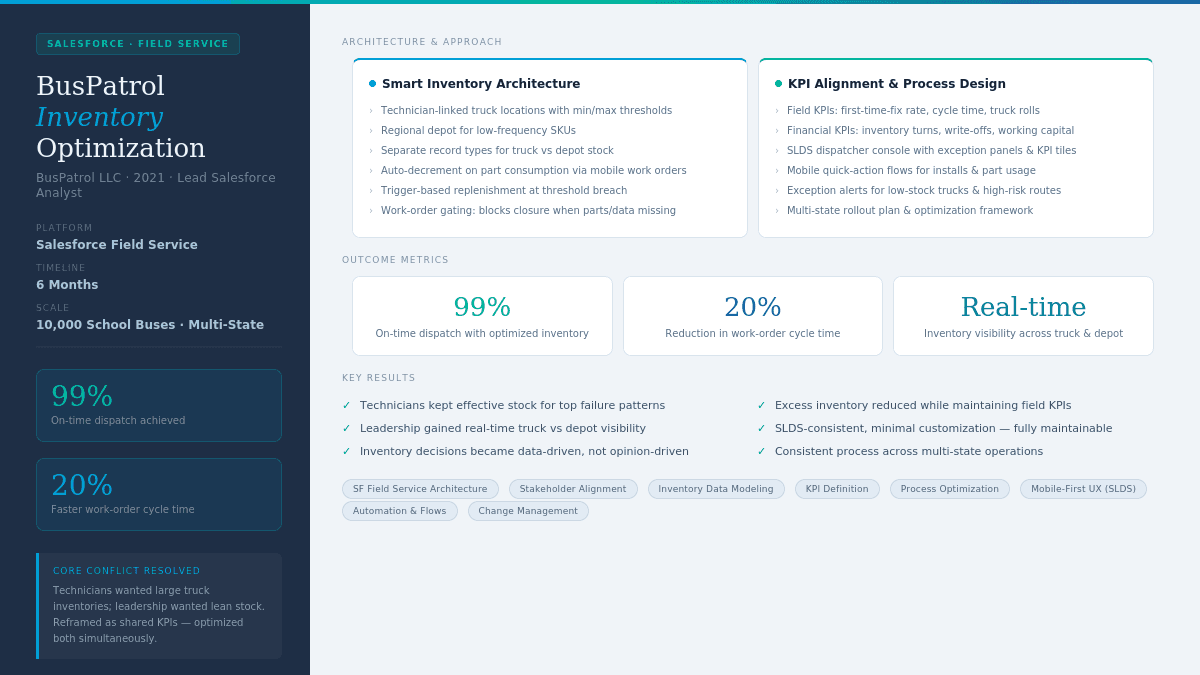
Instead of accepting this as an either/or choice, I reframed the problem: What if we could measure both priorities simultaneously and make decisions based on shared data?
I established explicit KPIs that aligned field operations and leadership around common success metrics:
- Field Metrics: First-time-fix rate, work-order cycle time, truck rolls per incident
- Financial Metrics: Inventory turns, write-offs per technician, working capital tied up in parts
This transformed the conversation from ‘technicians vs leadership’ to ‘how do we optimize both?’
Smart Architecture Design
Using standard Salesforce Field Service objects, I modeled a system that provided technicians the stock they needed without excessive inventory:
- Technician-linked truck-inventory locations with min/max thresholds
- Regional depot inventory for low-frequency SKUs
- Separate record types/layouts for truck vs depot stock
- Technicians logged consumption via mobile work orders; inventory managers/regional ops handled adjustments and optimization
Process Clarity
- Technicians: Log consumption via mobile
- Inventory Managers: Optimize profiles, manage replenishment
- Regional Ops: Oversee exceptions, thresholds, consistency
Automation & Control
- Auto-decrement truck inventory on part consumption
- Trigger replenishment requests at thresholds
- Block work-order closure when parts/data missing
- Exception alerts for low-stock trucks/high-risk routes
Strategic SLDS Customization
1) Dispatcher Console: SLDS exception panels and KPI tiles
2) Mobile App: SLDS quick actions for installs, part usage
3) Service Appointments: Cues for type, parts readiness, priority, certification
Key Principle: Configure strategically using standard patterns. Maximum maintainability.
Results
✅ 99% on-time dispatch achieved with optimized inventory management
✅ 20% reduction in work-order cycle time while maintaining first-time-fix performance
✅ Technicians retained effective stock levels for top failure patterns without carrying excessive inventory
✅ Leadership gained real-time visibility into truck vs depot inventory, consumption by work order, and impact on cycle time and cost
✅ Inventory decisions became data-driven, eliminating waste while maintaining field service KPIs
✅ Excess inventory reduced while improving operational performance across multi-state operations
✅ Solution remained maintainable and SLDS-consistent, with minimal customization
✅ Balance achieved: demonstrated translation of priorities into explicit metrics and process rules
Timeline: 6 months | Team: Field Service | Deployment: 10,000 School Buses
Skills Demonstrated
- Salesforce Field Service Architecture & Customization
- Stakeholder Alignment & Negotiation
- Data Model & Inventory Design
- Process Optimization & Workflow Design
- Mobile-First UX (SLDS/Lightning)
- Automation & Business Logic (Flows, Validation Rules)
- KPI Definition & Performance Metrics
- Change Management & User Adoption
- Multi-State Operations Management
Deliverables
Salesforce Configuration:
- Custom truck inventory object
- Location hierarchy (truck vs depot)
- Flows for auto-decrement/replenishment
- Validation rules/work-order gating
- Exception alerts/KPI dashboard
Process Design & Documentation:
- Inventory management runbook
- Data governance/audit trail docs
- KPI definitions & measurement
- Training plan for field technicians
User Experience/Launch:
- SLDS dispatcher console & KPI tiles
- Mobile quick-action flows
- Enhanced service appointment layouts
- Multi-state rollout plan and optimization framework
Key Messaging
BusPatrol’s Salesforce Field Service inventory project balanced technician effectiveness and financial discipline by reframing conflict around shared KPIs and pragmatic, maintainable Salesforce design. It showcases stakeholder management, standard architecture, and adoption at scale.
